I thought I’d compile it all here in one place just a few bits of my own experience strength and hope — along with some resources — that I frequently share with newcomers and sponsees. The BEST PLACE to get the right information about your recovery, though, is at an AA meeting (what is a meeting?), in the A.A. literature, in The Grapevine, a monthly publication by recovering alcoholics participating in the Twelve Steps of A.A, and — of course — your sponsor. I am only sharing what’s worked for me in my experience, I do not speak for A.A. as a whole, nor even a particular meeting or group. This is just my own personal experience, strength & hope.
- A running draft doc of slogans, mottos & cliches that I find meaningful.
- A collection of useful or just favorite literature passages, meeting readings & prayers/meditations/intentions.

The first three steps made simple:
- I can’t
- A power greater than me can
- I’ll let it (and let it go!)
The three most important principles:
- Honesty
- Open-mindedness
- Willingness
When someone says “G.O.D.” if that gets in the way, instead imagine it as:
- Gift Of Desperation
- Group Of Drunks
- Good Orderly Direction
Work this program and you too can be:
- Happy
- Joyous
- Free
A few pamphlets that may answer some of your questions
First: Are you an alcoholic?
Consider this parable:
One day long ago, over the hot sands of a Middle Eastern country, a white skylark flew in joyous loops about the sky. As she swooped near the earth, she heard a merchant cry out, ‘Worms! Worms! Worms for feathers! Delicious worms!’ The skylark circled about the merchant, hungry at the mention of worms but puzzled as to what the merchant meant. ‘Come here, my little friend. Come! See the lovely worms I have!’ Cautiously, the skylark landed and cocked her head at the merchant. Come! Taste the juicy worms!’ The skylark became aware that she was indeed quite hungry. And these worms looked bigger and tastier than any she had ever dug for herself out of the hardscrabble ground of the desert. The skylark hopped closer and put her beak up close for a worm. ‘Two worms for a feather, my friend. Two worms for one!’ The skylark was unable to resist. And she had, after all, so many feathers. So, with a swift motion, she pulled out a feather–just a small one–from beneath her wing and gave it to the merchant. ‘Take your pick, my little friend . . . any two, your heart’s desire!’ And so the skylark quickly snatched up two of the plumpest worms and swallowed her meal with delight. Never before had she tasted such wonderful worms. With a loud chirp, she leaped into the air and resumed her joyful flight. Day after day the skylark returned. But one day, after eating her fill, the skylark leaped again into the air–and to her horror, she fell to the ground with a thud. She was unable to fly! All at once, with a shock, she realized what had happened. From the delicious worms she had grown fatter and fatter. But, as she plucked her feathers, one by one, first her body, then her tail, and finally her very wings had grown balder and balder. Horrified, she remembered how, slowly, imperceptibly, day by day, it had been getting harder and harder to fly; and how she had told herself it was no matter; she could always stop before it was too late. Now, suddenly, here she was, trapped on the ground.
So if it’s not about will-power, what is actually happening?
When alcohol is consumed, the body and brain process ethanol through specific metabolic pathways, neurotransmitters, and biological systems. Below is a side-by-side comparison of standard metabolism versus chronic heavy drinking, detailing the precise chemical pathways, affected organs, neurotransmitters, and hormones involved.
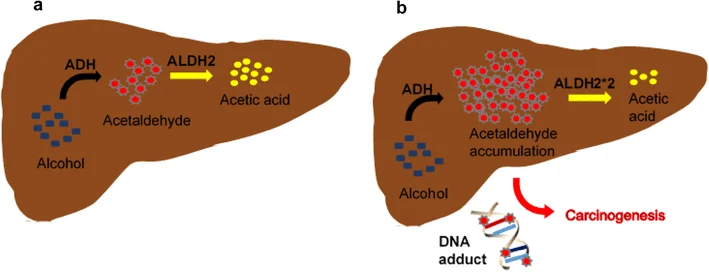
Under normal conditions, the liver metabolizes about one standard drink (14g ethanol) per hour. Ethanol is converted by Alcohol Dehydrogenase (ADH) into toxic Acetaldehyde, which Aldehyde Dehydrogenase (ALDH) rapidly breaks down into Acetate, before the Acetaldehyde has a chance to flood other organs. Acetate is ultimately converted by muscle tissue into water and carbon dioxide.
When drinking is too fast or heavy, this system breaks down and rewires both body and brain:
-
The Liver & Metabolic Damage: Excess ethanol triggers a backup pathway, the MEOS system (CYP2E1 enzyme). CYP2E1 generates acetaldehyde faster than ALDH can clear it, causing oxidative stress and liver injury. As it gets damaged, the liver will process the ethanol increasingly less efficiently, fueling a worsening metabolic feedback loop. When excess acetaldehyde levels overflow in the brain, acetaldehyde reacts chemically with dopamine to form a psychoactive compound called Salsolinol which binds to opioid and dopamine receptors in the brain’s reward pathway, and acts as a powerful secondary stimulus that reinforces compulsive drinking and intensifies psychological cravings, making it even harder to refuse a drink.
-
Brain Adaptation & Anxiety: Under normal circumstances, ethanol binds to GABA receptors harmlessly, giving a pleasant feeling. Chronic overstimulation causes damage to the receptors, and forces the brain to downregulate GABA receptors (requiring more alcohol to feel calm) and elevates dynorphin (suppressing dopamine and forcing a low-dopamine state where drinking is required just to feel normal). Simultaneously, elevated Cortisol and Corticotropin-Releasing Factor (CRF) in the amygdala create intense baseline anxiety when sober (hyperkatifeia).
-
Broken Brakes (Hypofrontality): Excessive alcohol damages the prefrontal cortex (PFC), weakening top-down impulse control. Even if a person intellectually knows drinking is harmful, the brain region needed to convert that logic into physical restraint is offline.
-
Hijacked Drive (Incentive Salience): As executive control fails, the reward system (nucleus accumbens) becomes hypersensitive. Cue-triggered dopamine surges assign alcohol an inflated survival priority, rerouting the urge to drink through primitive survival pathways like breathing or eating.
-
Negative Reinforcement: Motivation shifts from seeking pleasure to escaping psychological distress. Faced with alcohol, the brain views it as an immediate emergency exit from intolerable internal pain, instantly overriding long-term goals.
Any of these strike a chord?
“…that the phenomenon of craving is limited to this class and never occurs in the average temperate drinker.” – The Doctor’s Opinion (p. xxvi)
“The remorse, horror and hopelessness of the next morning are unforgettable. The courage to do battle was not there. My brain raced uncontrollably and there was a terrible sense of impending calamity… Sometimes I stole from my wife’s slender purse when the morning terror and madness were on me. …for the frightful day came when I drank once more. The curve of my declining moral and bodily health fell off like a ski-jump. …No words can tell of the loneliness and despair I found in that bitter morass of self-pity. Quicksand stretched around me in all directions. I had met my match. I had been overwhelmed. Alcohol was my master.” – Bill’s Story (p. 6-8)
“…for with it there goes annihilation of all the things worth while in life. It engulfs all whose lives touch the sufferer’s. It brings misunderstanding, fierce resentment, financial insecurity, disgusted friends and employers, warped lives of blameless children, sad wives and parents—anyone can increase the list. …How many times people have said to us: “I can take it or leave it alone. Why can’t he?’’ “Why don’t you drink like a gentleman or quit?’’ “That fellow can’t handle his liquor.’’ “Why don’t you try beer and wine?’’ “Lay off the hard stuff.’’ “His will power must be weak.’’ “He could stop if he wanted to.’’ “She’s such a sweet girl, I should think he’d stop for her sake.’’ “The doctor told him that if he ever drank again it would kill him, but there he is all lit up again.’’” – There is a Solution (p. 18-20)
“But what about the real alcoholic? He may start off as a moderate drinker; he may or may not become a continuous hard drinker; but at some stage of his drinking career he begins to lose all control of his liquor consumption, once he starts to drink.” – There is a Solution (p. 21)
“We alcoholics are men and women who have lost the ability to control our drinking. We know that no real alcoholic ever recovers control. All of us felt at times that we were regaining control, but such intervals—usually brief—were inevitably followed by still less control, which led in time to pitiful and incomprehensible demoralization.” – More About Alcoholism (p. 30)
“If, when you honestly want to, you find you cannot quit entirely, or if when drinking, you have little control over the amount you take, you are probably alcoholic.” – We Agnostics (p. 44)
“We were having trouble with personal relationships, we couldn’t control our emotional natures, we were a prey to misery and depression, we couldn’t make a living, we had a feeling of uselessness, we were full of fear, we were unhappy, we couldn’t seem to be of real help to other people… (the ‘Bedevelments’)” – We Agnostics (p. 52)
“The less people tolerated us, the more we withdrew from society, from life itself. As we became subjects of King Alcohol, shivering denizens of his mad realm, the chilling vapor that is loneliness settled down. It thickened, ever becoming blacker. Some of us sought out sordid places, hoping to find understanding companionship and approval. Momentarily we did—then would come oblivion and the awful awakening to face the hideous Four Horsemen—Terror, Bewilderment, Frustration, Despair. Unhappy drinkers who read this page will understand!” – A Vision For You (p. 151)
The Big Book of Alcoholics Anonymous defines the alcoholic in two ways:
- An alcoholic develops the phenomenon of craving: once the alcohol has entered their system, they lose the ability to stop.
- An alcoholic has lost the ability to control their drinking in a way a non-alcoholic can. They may not drink every single day, they may not drink all day, but more often than they’d like they drink at times and in amounts that they had not intended. Even if sometimes they’re able to stop after one or two drinks, often they’re just unable to.
If you find that you are experiencing consequences from drinking too much or two often–especially if you find you can’t stop once you start–and yet continue to talk yourself into drinking, hoping it might not happen again; you might be an alcoholic. Only a medical professional can truly diagnose you, but most of us knew what we were, before we got the official diagnosis.
Why is it important to take recovery seriously?
The mortality rate of those with alcohol use disorder is 4 times higher than the general population
Only 10% of Alcoholics seek treatment
CBT alone is 50% more effective than MAT alone (70% vs 50%) at helping alcoholics get sober
Of those who seek treatment, 70% fully complete their treatment program
Of those who complete treatment 62% remained sober a year later
Of those who complete treatment 33% are still sober 5 years later
Attending AA meetings at least once a week in the years after getting sober doubles your chances of maintaining long-term sobriety (67 vs 33%)
Attending therapy or counseling in recovery improves odds of achieving long-term sobriety by 50%
Approximately 33% to 36% of people who seek treatment achieve long-term sobriety (5+ years). Once this 5-year milestone is reached, the risk of relapse drops to less than 15%
10 Years: For those who reach 10 years of sobriety, the relapse rate falls further to less than 7%.
In a study, half of the participants who entered AA on their own were abstinent, while only a quarter of those who entered formal treatment were abstinent at the time of the follow-up
59% of AA members received some form of treatment or counseling before entering the program.
Bits & bobs
The Twelve Cliches (that actually bizarrely work)
- Don’t drink NO MATTER WHAT
- Stay open-minded, stay humble
- Trust a power greater than yourself
- Clean house
- Call your sponsor
- Get out of your head
- Ask for help
- First thing’s first & Easy Does It!
- Have an Attitude of Gratitude (as in make a gratitude list every day)
- Be rigorously honest
- Go to meetings ESPECIALLY when you DON’T feel like it – when you don’t WANT to go to a meeting is probably when you NEED it most
- Help others and be of service – this is a WE program!
12 Spiritual Principles
- HONESTY – Fairness and straight forwardness of conduct: adherence to the facts.
- HOPE – To expect with desire; something on which hopes are centered.
- FAITH – Complete confidence; belief and trust.
- COURAGE – Firmness of mind and will in the face of extreme difficulty; mental or moral strength to withstand fear.
- INTEGRITY – The quality or state of being complete or undivided; soundness.
- WILLINGNESS – Prompt to act or respond; accepted and done of choice or without reluctance.
- HUMILITY – Not proud or haughty; not arrogant or assertive; a clear and concise understanding of what we are, followed by a sincere desire to become what we can be.
- LOVE – Unselfish concern that freely accepts another in loyalty and seeks his good to hold dear.
- DISCIPLINE – Training that corrects, molds, or perfects the mental faculties or moral character; to bring under control; to train or develop by instruction.
- PATIENCE/PERSEVERANCE – Steadfast despite opposition or adversity; able or willing to bear; to persist in an understanding in spite of counter influences.
- AWARENESS – Alive and alert; vigilance in observing.
- SERVICE – A helpful act; contribution to the welfare of others; useful labor that does not produce a tangible commodity.
If you’re craving, before you take that drink:
- Play the tape forward (okay, the first drink might not kill you, but what about when you get drunk, what about in the morning, remember your past consequences). Think… think… think…
- Remember, this too shall pass
- Have you made a gratitude list today?
- Call your sponsor AND go to a meeting
- Use the one minute, one hour, one day at a time plan, and postpone the drink until tomorrow
How to strengthen your armor against that first drink:
- Have a sponsor and use that sponsor
- Have a home group, and a familiarity with a number of possible meetings you could attend every day, so you don’t have to search hard for a meeting to attend in a pinch
- Build a network of friends who make you feel comfortable in 12 step recovery that you connect with often and can be vulnerable with in times of trouble
- Try the advice and suggestions of old timers out, especially when it comes from several. It can’t hurt! If it doesn’t work for you, at least you tried!
- Build habits so that you’re working your 12 step program in a meaningful way at least a little bit every day, so you’re never very far from the things that ground you.
If you’re feeling restless irritable or discontent, ask yourself:
- When I am disturbed, what am I contributing to the situation (maybe it’s as simple as I’m just stubbornly not exiting a situation I really should be)?
- Acceptance is the answer to all of my problems today, how can I reframe the way I’m judging this situation to change my feelings?
- Am I hungry, angry, lonely or tired, and have I done all the things I need to do to take care of myself today, like make a gratitude list, take any medications I should have taken, showered, or done some physical exercise?
- Has someone in AA that I know gone through something similar, and can I ask them or even my sponsor for advice, or even if I can vent to them?
- Can I help someone else who may be feeling even worse than I am today to get out of my head?
When you’re feeling your feelings and it’s a lot:
- Feelings are normal, natural, and human, but feelings arise out of a subjective judgment we make or a conclusion we come to in response to a stimulus or situation, and not all our judgements are going to be correct. In other words, “feelings aren’t fact.”
- Feelings – as uncomfortable and downright miserable as they can be – cannot cause us permanent injury or harm. And they eventually change. In other words, “this too shall pass.”
- Most things in life we have no control over – especially other people’s behaviors and judgements, the weather, traffic, or people standing in our way on the escalator, etc. – but we do have control over our own judgments, and if we’ve made a judgment or come to a conclusion causing us distress, we have the power to reassess that judgment, and rethink our take on that particular situation. So, instead of getting angry or upset over something we’ll never be able to control, and truly noone in our shoes would be able to control, why don’t we try acceptance? In other words, “accept life on life’s terms.”
- When we hit an unexpected detour in the path we’re on, we may mourn the loss of things we had been anticipating on that path. But we fail to consider there may be even better things coming our way down this diversion. In other words, “look for the silver lining.”
- Negative feelings often make us feel isolated and cut off. The irony is that navigating these feelings is one thing every human being has in common with every other human being. If we reach out to someone else we trust in the program, not only might they be able to help us tangibly, but it may make the heaviness of the situation feel lighter. And we’ll be deepening our relationship and connection with those we share with. In other words, “a burden shared is cut in half, but joy shared is doubled.”
Acronyms:
- HALT: Hungry, Angry, Lonely Tired
- FEAR: False Evidence Appearing Real
- HOPE: Hearing Other People’s Experience
- ISM: Incredibly Short Memory
- YET: You’re eligible too
Watch out for:
- Expectations are Planned Resentments – live and let live!
- Restless, Irritable & Discontent
- Terminal Uniqueness
- Alcoholism is Cunning, Baffling & Powerful
- Alcoholism is a disease that’s Incurable, Progressive & Fatal

Questions you may have for someone who has been around
What is a sponsor?
A sponsor isn’t a guru, boss, life coach, therapist, best friend, drill sergeant, or anything like that. It’s just an AA member who usually has more than a year of recovery, has worked the 12 steps with THEIR sponsor, and can share with you how they were able to stay sober through life’s ups and downs, and that’s all. If you are relatively new (under 5 years) and haven’t worked the steps yet, they should probably have collected more time sober than you – because they will probably have gotten through more challenges soberly, and can show you how.
A sponsor isn’t here to give you life advice, or coach you to material success. All they should do is share what worked for them, and give you their take on the steps of AA. A sponsor doesn’t make any demands of you, but may make suggestions when it comes to helping you understand your recovery.
To find a good sponsor, look for someone whose point of view on recovery and sobriety resonates with you, or as the old timers say “look for someone who has what you want,” not in terms of material things, or the “cash and prizes,” but someone who has what you want spiritually. Stick with the winners!
Where should I start with all this literature?
I always recommend starting with a copy of Living Sober, by AAWS (find it at a local library). It’s a guide to dealing with the new realities in early sobriety. Living Sober is NOT the program of recovery, it’s just helpful tips to manage all the new things that will come up in your early days. The most important book in sobriety is the “Big Book,” of Alcoholics Anonymous by AAWS (find it at a local library), which has the entire program in it’s first 164 pages. It’s best to sit down with a sponsor to read this together to discuss what it really means. Yes, it’s old, and it uses a lot of old slang, and outdated terms, but there’s invaluable truth in there. If you’re really having trouble with the language, I recommend grabbing a copy of The Plain Language Big Book by AAWS (find it at a local library), and using it as a study guide for the real Big Book. The Plain Language Big Book removes the confusing turns of phrase, and explains exactly what is meant by what is on the page. Once you begin working the steps, I recommend having a copy of the Twelve Steps & Twelve Traditions by AAWS. An additional helpful book here is The Little Red Book by Hazelden. Finally, as you develop a daily practice of recovery and fellowship, it is good to get yourself a copy of Daily Reflections by AAWS, and I also highly recommend 24 Hours A Day by Hazelden.
What is a 90 in 90?
In AA, the term “90 in 90” is a suggestion for individuals in early recovery to attend 90 AA meetings in the first 90 days of their sobriety. This practice is believed to provide support, plug into a sober network, and help individuals establish a foundation for recovery by actively engaging in the fellowship and principles of Alcoholics Anonymous.
The old timers say “meeting makers make it.” Completing a “90 in 90” in AA can be valuable for someone in early recovery as it offers a structured and intensive immersion into the fellowship and principles of AA. While a 90 in 90 can be a mix of online, hybrid, and in-person meetings, the bulk of the benefit – especially getting plugged into a network of sober fellowship – is most experienced at in-person meetings, so the bulk of these meetings should be in-person.
By attending 90 meetings in the first 90 days, individuals can establish a consistent routine, build a robust support network, and gain exposure to various recovery experiences and strategies. The daily engagement helps break the isolation often associated with addiction, keeps individuals focused on their commitment to sobriety, and provides ample opportunities to work through AA’s Twelve Steps. It is ideal to plan ahead and know what meeting you will be attending the next day, before going to bed. This concerted effort during the initial phase of recovery not only fosters a sense of community but also enhances the likelihood of long-term success by reinforcing the principles and practices integral to sustained sobriety.
What is fellowship?
Fellowship in AA means two related things: The Fellowship of AA is the common community of alcoholics with a desire to recover relating to and helping one another, and fellowship is also the act of building and strengthening that community with special activities, getting together with other AA fellows for dinner, brunch, or coffee, or just coming to a meeting early and staying late and talking to people. This is a “WE” program, we help one another stay sober, we don’t do it alone.
What does it mean to identify in?
When someone tells you to “identify in,” they are telling you to find a personal connection or resonance with the experiences, emotions, or struggles shared by another member during a meeting. It signifies a recognition that your own journey in overcoming alcohol addiction aligns with the narrative or feelings being discussed. By identifying in, individuals acknowledge a commonality of experience and often find comfort and support in realizing that they are not alone in their challenges. This practice fosters a sense of unity and understanding within the AA community, reinforcing the belief that shared identification can contribute to the strength and effectiveness of the recovery process.
Sometimes you’ll meet people in meetings that rub you the wrong way. Maybe you think you’re better than them (remember, “there but for the grace of G.O.D. go I). Maybe you think they think they’re better than you (remember, “live and let live). It doesn’t matter. You can learn something from everyone in a meeting, even if what they have to teach you is what NOT to do. If you really are open minded, though, you will find what you have in common with that person, because ultimately, all of us alcoholics share way more in common than we have differences. Remember to place principles over personalities!
Why do I have to talk during meetings?
Even if you don’t feel like you want to talk during a meeting, sharing during a meeting can not only be good for you, but for someone else in the meeting. You never know who may resonate with what you are saying, and you never know who you may be helping, so if you have the opportunity to speak during a meeting, go ahead and share your experience, share your strength, and share your hope. But remember, when possible, bring your problem to your sponsor, and share the solution at the meeting.
Why should I do the steps?
AA does not teach anyone how to stop drinking. Most alcoholics can and have stopped drinking (for a time). But cold turkey, without any other help or structure, it’s either difficult for us to STAY stopped. And even when we do, we feel miserable. AA doesn’t teach us how to stop drinking, but how to LIVE SOBER. This means serenely managing the regular and unexpected ups and downs of life, comfortably and emotionally balanced, without the need for a chemical crutch.
Engaging in the Twelve Steps of AA is crucial for someone in the program as it provides a systematic and transformative framework for achieving and maintaining sobriety – for LIVING SOBER. The steps guide individuals through a process of self-reflection, amends, spiritual growth, and continued recovery.
Working the steps allows individuals to address the root causes of their addiction, develop a deeper understanding of themselves, and foster personal and spiritual growth. It involves making amends for past wrongs, making a conscious effort to live a more principled life, and helping others in their journey to recovery. The Twelve Steps serve as a roadmap for a holistic and sustainable recovery, offering a structured path toward lasting sobriety and a meaningful, purposeful life free from the grip of alcohol addiction.

Literature links
Daily Reflections
Living Sober
- Official page, with audio book.
- Title Page through Page 17
- Pages 18-32
- Pages 33-49
- Pages 50-63
- Pages 63-71
- Pages 72-85
- Page 87 (The Twelve Steps)
- Pages 89-92
The Big Book of Alcoholics Anonymous
- Official page, with audio book and video resources.
- Title Page – (pp. iii)
- Copyright Information – (pp. ii)
- Contents (pp. v-x)
- Preface – (pp. xi-xii)
- Foreword to First Edition – (pp. xiii-xiv)
- Foreword to Second Edition – (pp. xv-xxi)
- Foreword to Third Edition – (pp. xxii)
- Foreword to Fourth Edition – (pp. xxiii-xxiv)
- The Doctor’s Opinion – (pp. xxv-xxxii)
- Bill’s Story – (pp. 1-16)
- There is a Solution – (pp. 17-29)
- More About Alcoholism – (pp. 30-43)
- We Agnostics – (pp. 44-57)
- How It Works – (pp. 58-71)
- Into Action – (pp. 72-88)
- Working With Others – (pp. 89-103)
- To Wives – (pp. 104-121)
- The Family Afterward – (pp. 122-135)
- To Employers – (pp. 136-150)
- A Vision For You – (pp. 151-164)
- How Forty-Two Alcoholics Recovered From Their Malady – (pp. 165-166)
- PART I – Pioneers of A.A. – (pp. 169-276)
- PART II – They Stopped in Time – (pp. 277-431)
- PART III – They Lost Nearly All – (pp. 435-559)
- APPENDICES:
The Book of The Twelve Steps & Twelve Traditions
- Official page, with audio book and video resources.
- Copyright Information – (p. B-2)
- Contents – (pp. 5-13)
- Introduction – (p. 14)
- Foreword – (pp. 15-18)
- Step One – (pp. 21 – 24)
- Step Two – (pp. 25 – 33)
- Step Three – (pp. 34 – 41)
- Step Four – (pp. 42 – 54)
- Step Five – (pp. 55 – 62)
- Step Six – (pp. 63 – 69)
- Step Seven – (pp. 70 – 76)
- Step Eight – (pp. 77 – 82)
- Step Nine – (pp. 83 – 87)
- Step Ten – (pp. 88 – 95)
- Step Eleven – (pp. 96 – 105)
- Step Twelve – (pp. 106 – 125)
- Tradition One – (pp. 129 – 131)
- Tradition Two – (pp. 132 – 138)
- Tradition Three – (pp. 139 – 145)
- Tradition Four – (pp. 146 – 150)
- Tradition Five – (pp. 151 – 155)
- Tradition Six – (pp. 156 – 160)
- Tradition Seven – (pp. 161 – 167)
- Tradition Eight – (pp. 168 – 173)
- Tradition Nine – (pp. 174 – 178)
- Tradition Ten – (pp. 179 – 182)
- Tradition Eleven – (pp. 183 – 186)
- Tradition Twelve – (pp. 187 – 191)
- The Twelve Traditions (The Long Form) – (pp. 192 – 195)
Alternative Versions of the Literature
These versions remove gendered or other dated language that may trip people up. These are NOT official versions of the Literature, and if you want to get or stay sober, I highly recommend becoming more comfortable with the Conference Approved literature. However, if the language in these texts is too distracting for you, and you are having difficulty getting the message, these alternative versions can be like training wheels for your literature bike. I do not recommend these as a long term crutch though!
The Big Book of Alcoholics Anonymous: An Alternative Edition (Not Conference Approved)
Plain Language Big Book: A Tool for Reading Alcoholics Anonymous (Conference Approved)
Twelve Steps & Twelve Traditions Inclusive Remix (Not Conference Approved)
Living Sober (alternative inclusive edition) (Not Conference Approved)
Links & Phone Numbers
AA in DC, Montgomery County & Prince George’s County, Maryland
WAIA – Washington Area Intergroup Association
4530 Connecticut Ave. NW Suite 111
Washington, DC 20008
24-Hour Hotline: 202-966-9115
WAIA Directions
WAIA In Person Meeting List
WAIA Online Meeting List
Triangleclub.org – Washington DC area LGBTQIA+ 12-Step Recovery Clubhouse
AA in Northern Virginia
Northern Virginia Intergroup
10400 Eaton Place, Suite 140
Fairfax, VA 22030
24-Hour Hotline: 703-293-9753
NVI Directions
NVI Meeting List
AA USA-National
AA.org – Alcoholics Anonymous World Services, Inc home
Find an AA Meeting Near You
Online Intergroup — Find an Online Meeting anytime, anywhere
GaL-AA.org – Affinity group of LGBTQIA+ folk in Alcoholics Anonymous
Alanoclubs.org/directory – Directory of Alano Clubs
Chat with someone NOW
Get AA Literature
AA General Service Office
475 Riverside Drive at West 120th St. 11th & 8th Floors
New York, NY 10115
212-870-3400
Contact GSO by Mail
General Service Office
P.O. Box 459
Grand Central Station
New York, NY 10163
Box 459 – the AA Newsletter
AA Grapevine/La Vina – Independent International Journal of Alcoholics Anonymous
Helpful Apps for you
The Meetings Gude App
Get to in person meetings
- Apple: https://apps.apple.com/us/app/meeting-guide/id1042822181
- Android: https://play.google.com/store/apps/details?id=org.meetingguide
The Everything AA App
It has a sobriety counter, the Daily Reflection updated daily, the full text of the Big Book (current edition), the full text of the Twelve Steps & Twelve Traditions, full text of Living Sober, AND you can LISTEN to the audio version all of the above–not to mention these great speaker tapes by Joe & Charlie that have been really popular among AA folks for decades. In addition, it has the official AA pamphlets on different issues, lists of prayers and meditations, a gratitude list maker, a nightly inventory, meeting finder, and a ton more. It really is everything AA.
- Apple – https://apps.apple.com/us/app/everything-aa/id1565768051
- Android – https://play.google.com/store/apps/details?id=com.bigbook3
The AA Grapevine App
Featured articles, the AA Grapevine podcast, and if you’re subscribed to the AA Grapevine, you can get the PDF and audio versions in the app.
- Apple – https://apps.apple.com/us/app/aa-grapevine/id6450056498
- Android – https://play.google.com/store/apps/details?id=org.aagrapevine.app&pli=1
The AA Grapevine Podcast
Not an app (though available in the Grapevine App), the Grapevine podcast is a lighthearted monthly look at the experience of AA members today.
https://www.aagrapevine.org/podcast
The My Spiritual Toolkit App
The “My Spiritual Toolkit” app has a lot of great functionality. On the main homepage, you can see how much time you have, broken down to THE HOUR, which reminds you how much you’ve accomplished. Under that, read the “Daily Reflection,” updated automatically every day, and read “On Awakening” from the Big Book. There are also a lot of REALLY GOOD PRAYERS right under On Awakening.Under Tools, you’ll see “Spot Check Inventory,” “Nightly Inventory,” and “Gratitude List,” among other things. You can fill in the gratitude list, save it, and turn around and copy and paste it into text, or share through email. It then saves your old lists so you can go back and read them. Nightly Inventory is just a check in before bed to hold YOURSELF accountable for living up to your own expectations. How well did you keep the promises to yourself today? What victories can you celebrate? Feel free to ALSO save and share nightly inventory with me IF YOU WANT. But it’s for you. Spot check Inventory is an emergency emotional sobriety intervention tool. When you feel disturbed in any way — mad, sad, afraid, anxious, annoyed, agitated, distracted, distraught, shocked, or sanctimonious — pull this out and do a quick examination of your thoughts and judgements, to maybe move more quickly into feeling more serene. You can ALSO save and share these with me any time.